
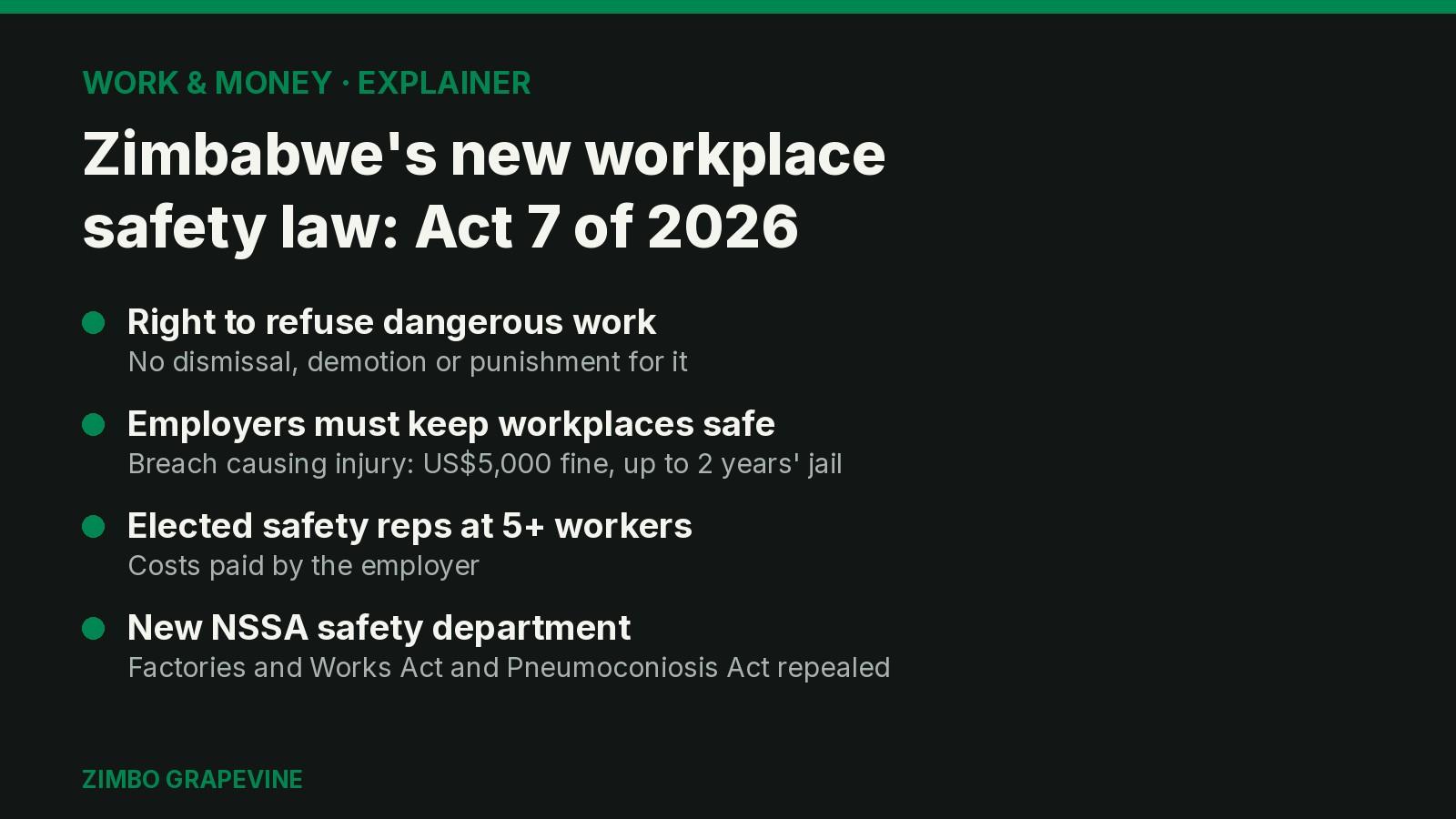
Workers in Zimbabwe now have a legal right to refuse work that puts their life or health in immediate danger, and employers cannot fire, demote or punish them for doing so, under a new workplace safety law signed by President Mnangagwa.
The law is listed on ZimLII, the free legal information service, as the Occupational Health and Safety Act, 2026 (Act 7 of 2026), published in the Government Gazette on 16 October. Zimpapers titles call it the Occupational Safety and Health Act. The Herald reported its contents on 19 and 25 October, and Pindula carried the same details, crediting The Sunday Mail.
What changes for workers
The key clause is Section 14(1), as reported by The Herald: "Every worker shall have the right to refuse to do work which is likely to cause imminent danger to his or her safety or health which has not been rendered safe."
That right comes with protection. According to The Herald and Pindula, a worker who refuses unsafe work cannot be dismissed, demoted or otherwise penalised for it.
Workplaces with five or more workers must let staff elect their own safety and health representatives, and the employer pays the costs.
What changes for employers
Under Section 13, employers must provide a safe working environment. An employer whose breach of the law causes injury faces a Level 14 fine, reported as US$5,000, up to two years in prison, or both.
New bodies, old laws gone
The Act sets up an Occupational Safety and Health Department under the National Social Security Authority (NSSA) and a Medical Bureau of Occupational Diseases. It repeals two older laws, the Factories and Works Act and the Pneumoconiosis Act, The Herald reported. The Herald's 19 October report said inspectors will cover all sectors, including the informal economy.
Why it matters
Many Zimbabweans work in mines, factories, building sites and farms, where a worker who complains about safety can fear for their job. Until now the main rules sat in the older Factories and Works Act. A clear right to say no, backed by protection from dismissal and penalties for employers, shifts some of that power back to workers.
UK-based readers will recognise the idea: British law has long protected workers who leave or refuse to return to a workplace they reasonably believe is seriously dangerous.
What is not yet clear is when each section takes effect, and how inspectors will reach small and informal workplaces in practice. The real test will be enforcement: whether NSSA's new department has the staff to inspect sites, and whether courts back workers who use the new right.
Sources: ZimLII, Occupational Health and Safety Act, 2026 (Act 7 of 2026): https://zimlii.org/akn/zw/act/2026/7/eng@2026-10-16 · The Herald (Farirai Machivenyika), 25 Oct 2026: https://www.heraldonline.co.zw/workers-now-have-a-right-to-refuse-dangerous-work-2/ · Zimbabwe Situation (Herald republish), 25 Oct 2026: https://www.zimbabwesituation.com/news/workers-now-have-a-right-to-refuse-dangerous-work/ · The Herald (Farirai Machivenyika), 19 Oct 2026: https://www.heraldonline.co.zw/safety-act-to-modernise-workplace/ · Pindula News, 25 Oct 2026: https://news.pindula.co.zw/2026/10/25/workers-can-now-legally-refuse-dangerous-work-under-new-act/

Comments
Comments are moderated before they appear. Please read our comments policy.
Loading comments…