
Climate shocks are putting girls at greater risk of child marriage, unintended pregnancy and violence, according to a new report by the children's charity Plan International. Zimbabwe is one of five countries in the study, and the report calls it the worst affected country, with almost every girl surveyed reporting harm to her household.
The report, Change Her Forecast: State of the World's Girls 2026, was published ahead of the International Day of the Girl on 11 October. It draws on a survey of 5,000 girls and young women aged 15 to 24 in Bangladesh, Kenya, Peru, Senegal and Zimbabwe, plus interviews and focus groups with 139 of them. Plan International also says it analysed health and climate data from 52 countries over three decades.
What the report found in Zimbabwe
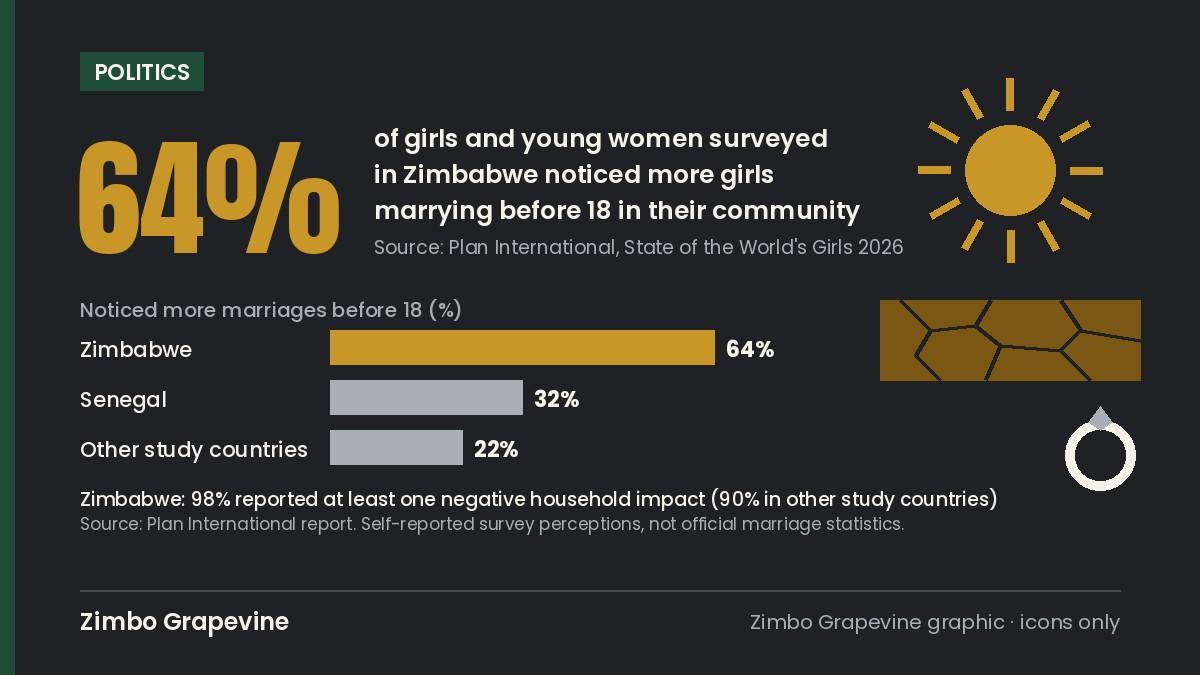
According to the report, nearly two-thirds of Zimbabwean respondents, 64 per cent, said they had noticed more girls getting married before 18 in their community. That compares with 32 per cent in Senegal and 22 per cent in the other study countries. The report says this increase is largely attributed to financial pressure.
The report says Zimbabwe, "where drought was the main climate event across many years, emerges as the worst affected country". It found that 98 per cent of Zimbabwean girls and young women reported at least one negative impact on their household, against 90 per cent across the other study countries combined.
The report also says 60 per cent of respondents in Zimbabwe had noticed more girls and young women in their community experiencing gender-based violence. That was the highest figure of the five countries, ahead of Kenya at 34 per cent.
It describes how the pressure builds. "In Zimbabwe, drought destroys harvests and income, leaving families unable to pay school fees or feed all household members," the report says. It adds that some girls "sometimes enter relationships with older men to access food, money, or basic necessities". Interviewees told the researchers that early marriage in Zimbabwe typically happens between the ages of 15 and 17.
One 21-year-old participant from Zimbabwe recalled the 2024-25 drought: "We had no harvests, no food and water."
School as protection
The report argues that keeping girls in school is the strongest protection. Plan International says girls whose schooling was disrupted were twice as likely to marry young or face an unintended pregnancy.
A 17-year-old Zimbabwean participant told the researchers: "Girls dropping out of school enter into early unions. They have unwanted sexual advances from out-of-school boys who have nothing to do. The pressure is too much."
The report also notes what helped. It says awareness campaigns on sexual and reproductive health and child marriage, run by the government and NGOs in Zimbabwe, "provided some protection". Girls described sanitary product distributions and sexuality education from the Campaign for Female Education (CAMFED) and Plan International as support that helped keep them in school.
Zimbabwean participants also named support they said was missing: continued education for pregnant girls and young mothers, food aid, and help with livelihoods such as small-scale farming, goats, chickens and boreholes.
The wider picture
Across all five countries, the report says 36 per cent of respondents had noticed more girls getting married before 18 in their communities, and 11 per cent said they had themselves married before 18. A third, 33 per cent, said they had noticed more unintended pregnancies in their community.
Plan International says prolonged drought was "the hazard most consistently associated with rising rates of child marriage and early unions" in its analysis. Because slow-onset drought "rarely triggers an emergency response", it says, the damage "accumulates unseen".
French broadcaster RFI also reported on the findings, noting that more than a third of participants saw more marriages before 18 in their communities, often for financial reasons after climate events.
What Plan International is calling for
Ahead of the COP31 climate talks, the charity is calling on governments and donors to keep schools open and free during climate shocks, to set aside a defined share of climate adaptation finance for adolescent girls' health, to include menstrual products, contraception and protection services in every emergency response, and to reach the most marginalised girls.
"Girls cannot continue to be treated as an afterthought in climate action," said Plan International's chief executive, Reena Ghelani.
The figures are self-reported: they reflect what girls and young women said they had seen in their communities, not official marriage records.
What the law says
Child marriage is illegal in Zimbabwe. Section 3(1) of the Marriages Act of 2022 says: "No person under the age of eighteen years may contract a marriage or enter into an unregistered customary law marriage or a civil partnership." The Act prohibits anyone from contracting, solemnising, promoting, permitting or coercing a child marriage, or pledging a child in marriage. Anyone other than the child who breaks that rule faces a fine, up to five years in prison, or both. The Act treats it as an aggravating factor if the offender is the child's parent or guardian.
The Act followed a 2016 Constitutional Court ruling. In Mudzuru and Another v Minister of Justice, Legal and Parliamentary Affairs and Others, decided on 20 January 2016, the court declared invalid the section of the old Marriage Act that allowed girls to marry at 16, and held that no person under 18 may enter any form of marriage, whether civil, customary or religious.
Where to get help
If you are worried about a child at risk of early marriage or abuse, Childline Zimbabwe runs a free helpline 24 hours a day on 116, from any phone on any network. It can also be reached on WhatsApp on +263 719 116 116.
Sources: Plan International, "Change Her Forecast: State of the World's Girls 2026" (report page): https://plan-international.org/publications/change-her-forecast/ · Plan International, full report (PDF): https://cdn.uc.assets.prezly.com/0f6d8cb6-880c-4f48-a074-ea510842ee05/-/inline/no/EN-SOTWGR-2026-Full-report-WEB.pdf · Plan International press release, 4 Oct 2026: https://plan-international.org/news/2026/10/04/climate-shocks-put-girls-at-risk-child-marriage-violence-teen-pregnancy/ · RFI, 11 Oct 2026: https://www.rfi.fr/fr/environnement/20261011-le-changement-climatique-aggrave-l-avenir-des-jeunes-filles-selon-une-%C3%A9tude · Marriages Act [Chapter 5:15], 2022 (ZimLII): https://zimlii.org/akn/zw/act/2022/1/eng@2022-05-27 · Mudzuru & Anor v Minister of Justice & Ors [2016] ZWCC 12 (ZimLII): https://zimlii.org/akn/zw/judgment/zwcc/2016/12/eng@2016-01-20 · Childline Zimbabwe: https://www.childline.org.zw/



Comments
Comments are moderated before they appear. Please read our comments policy.
Loading comments…